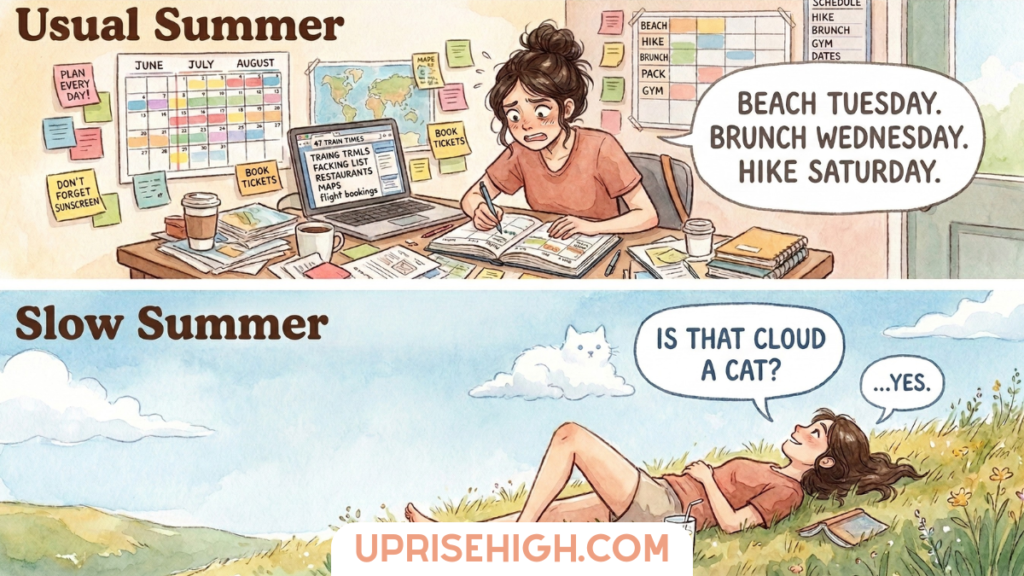
8 Quiet Habits of Genuinely Happy People
By Varun Pahwa • March 31, 2026

You’ve been trying to be happy.
That’s exactly the problem.
You probably have a friend like this. She shows up at gatherings, at work, just around. Nothing seems to rattle her. She laughs easily. A regular Tuesday in her company feels like it was worth having.
And if you’re like me, you’ve spent time wondering what she’s got figured out that you haven’t.
I tried for years to crack it. Journals, gratitude lists, morning routines. I optimized hard for happiness and kept feeling further from it.
It took me an embarrassingly long time to see I was the problem.
Happy people aren’t doing more.
They’re doing less, but differently.
This is about what that friend is actually doing. Some of it will surprise you. At least one thing will make you think of her specifically and suddenly understand why she is the way she is.
They gave up on being happy
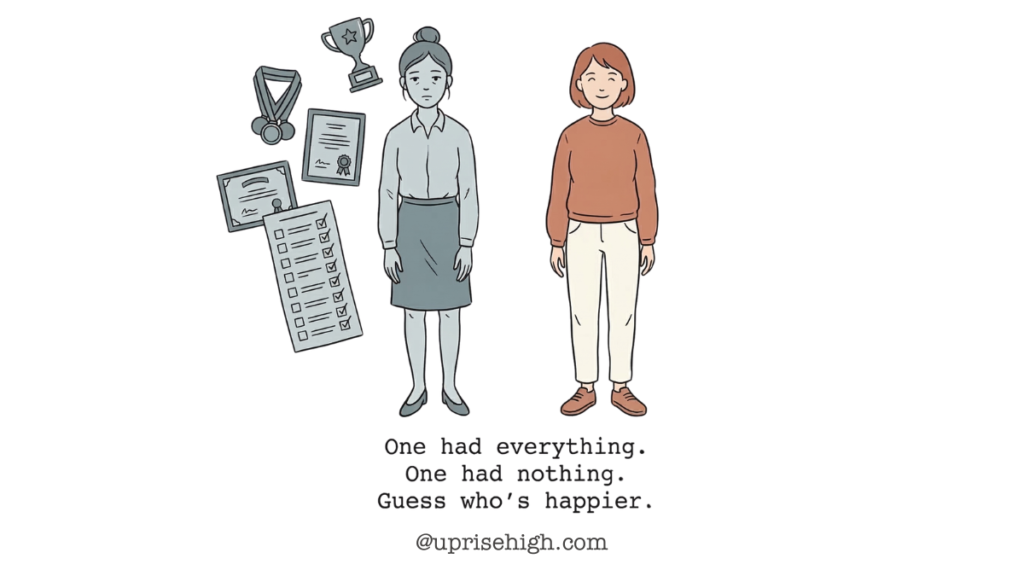
Iris Mauss ran studies on this. People who actively pursue happiness end up less happy than people who don’t even bother.[1] Chasing it makes it worse.
Once happiness becomes a goal, ordinary days start feeling like they’re not enough. A quiet evening feels like wasted time. A bad mood feels like falling behind. Everything becomes proof you’re not there yet.
Your friend has never done this. She just shows up, curious about whatever’s happening in front of her. Happiness isn’t something she’s chasing. It just seems to trail her around.
The first step isn’t adding anything. It’s quitting something.
They talk to strangers
Researcher Nicholas Epley found that people consistently underestimate how much a brief exchange with a stranger lifts their mood.[2] Not a deep conversation. Just something real with someone they’ll probably never run into again.
Your friend does this without a second thought. Says something to the person behind her in the coffee queue. Asks the market vendor how their morning’s going. Nothing significant. But she walks away from those moments a little lighter and so does the other person, whether they notice it or not.
We don’t do this because we assume strangers aren’t interested. Epley’s research shows that’s almost always wrong. Everyone is waiting for someone else to go first.
She just goes first.
They assume people like them
Most of us leave a conversation and immediately start replaying it. Did that sound weird? Was I talking too much? What did they think of me?
Your friend just… doesn’t. The conversation happened, it was fine, she’s already moved on. It doesn’t occur to her to go back in and pick it apart.
Researchers call this the liking gap.[3] We almost always underestimate how much people enjoy talking to us. The other person walked away feeling good about the exchange. We’re the only ones still standing there second guessing it. That mental loop costs more than we realise.
They pick “good enough” and move on

Psychologist Barry Schwartz studied two types of people. Maximizers, aka, people who need the best possible option before they can commit. And satisficers, aka, people who pick the first option that feels good enough and stop looking.[4]
Maximizers usually make objectively better choices. Better jobs, better deals, better outcomes on paper.
BUT they’re also less happy.
Your friend is a satisficer. She picks the restaurant that looks decent, books the first reasonable option she finds, orders without reading every item twice. This isn’t settling. She’s just figured out that the effort it takes to optimize a dinner reservation isn’t worth what you get back.
They let small things go
Someone cuts her off in conversation. A friend cancels last minute. The barista gets her order slightly wrong.
She notices. Then moves on.
People who struggle with their mood tend to catch everything: a flash of irritation on someone’s face, a slightly clipped response, a moment of inattention.[5] Every small thing becomes something to process. Something to carry.
Your friend doesn’t carry it. Not because she missed it (she didn’t), but because she let it go before it stuck. The annoyance passed through and that was it.
The rest of us are carrying a quiet running tally of small grievances, accumulated since morning.
She just never started the tally.
They invest deeply in a few people rather than widely in many

Your friend isn’t the person with a hundred acquaintances. She has a small circle, two or maybe three people she actually talks to. Not catching up. Talking.
She picks up even when it’s inconvenient. Remembers the thing you mentioned three weeks ago. When something happens, good or bad, she’s the first person you think to call. Not because you have to. Because you know she’ll show up.
The Harvard Study of Adult Development, the longest happiness study ever run, found that the single strongest predictor of happiness across a lifetime wasn’t money, career or health. It was the quality of close relationships.[6] Not how many. How honest.
You probably already know which relationships in your life feel like that.
And which ones don’t.
They spend money on time, not things
Our extra money usually goes toward something tangible. Something we can hold. It feels like the responsible move.
Your friend doesn’t do this. She pays for grocery delivery and doesn’t feel guilty about it. She calls the cab instead of circling for parking. She orders dinner on a Tuesday she’s too tired to cook and doesn’t spend the next hour resenting the dishes.
Not because she’s lazy. Because she’s figured out something we haven’t.
One Harvard study found that people who spend money to buy back time consistently report higher happiness than people who spend the same money on things.[7] Not occasionally higher. Consistently.
Material things give us a dopamine hit and then just… exist in our house. The evening we bought back? We actually remember it.
They accept bad feelings without guilt
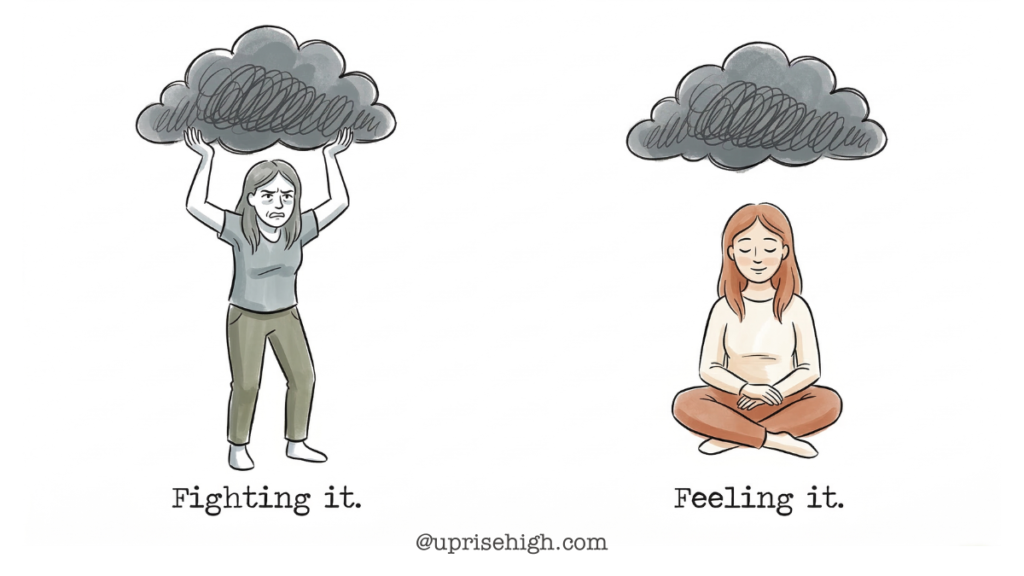
Most of us aren’t unhappy because life is hard. We’re unhappy because we’ve declared war on our own feelings and we’re losing.
A bad mood shows up and we immediately try to fix it. Reframe it, journal it out, go for a walk, call someone. Every uncomfortable emotion becomes a problem that needs solving. When the solution doesn’t work, we feel worse than before we started.
But you know what? People who just let their negative emotions be, without judging them, fighting them, or trying to replace them actually, experience fewer negative emotions over time.[8]
Not because they’re suppressing anything. Because they stopped adding a second problem on top of the first one.
Your friend has a bad day and just has it. She doesn’t perform wellness at herself. She lets it be what it is, and by the time evening comes it’s usually already shifting.
The feeling was never the problem.
The fight was.
Which of these do you already do?
Check the ones that feel natural to you. Not the ones you wish were true.
Which of these 8 habits surprised you most? Tell me in the comments.
↓ Sources & References
- Mauss, I. B., Tamir, M., Anderson, C. L., & Savino, N. S. (2011). Can seeking happiness make people unhappy? Paradoxical effects of valuing happiness. Emotion, 11(4), 807–815. https://doi.org/10.1037/a0022010
- Epley, N., & Schroeder, J. (2014). Mistakenly seeking solitude. Journal of Experimental Psychology: General, 143(5), 1980–1999. https://doi.org/10.1037/a0037323
- Boothby, E. J., Cooney, G., Sandstrom, G. M., & Clark, M. S. (2018). The liking gap in conversations: Do people like us more than we think? Psychological Science, 29(11), 1742–1756. https://doi.org/10.1177/0956797618783714
- Schwartz, B., Ward, A., Monterosso, J., Lyubomirsky, S., White, K., & Lehman, D. R. (2002). Maximizing versus satisficing: Happiness is a matter of choice. Journal of Personality and Social Psychology, 83(5), 1178–1197. https://doi.org/10.1037/0022-3514.83.5.1178
- Harkness, K. L., Sabbagh, M. A., Jacobson, J. A., Chowdrey, N. K., & Chen, T. (2005). Enhanced accuracy of mental state decoding in dysphoric college students. Cognition and Emotion, 19(7), 999–1025. https://doi.org/10.1080/02699930541000110
- Waldinger, R., & Schulz, M. (2023). The good life: Lessons from the world’s longest scientific study of happiness. Simon & Schuster. https://www.simonandschuster.com/books/The-Good-Life/Robert-Waldinger/9781982166700
- Whillans, A. V., Dunn, E. W., Smeets, P., Bekkers, R., & Norton, M. I. (2017). Buying time promotes happiness. Proceedings of the National Academy of Sciences, 114(32), 8523–8527. https://doi.org/10.1073/pnas.1706541114
- Ford, B. Q., Lam, P., John, O. P., & Mauss, I. B. (2018). The psychological health benefits of accepting negative emotions and thoughts: Laboratory, diary, and longitudinal evidence. Journal of Personality and Social Psychology, 115(6), 1075–1092. https://doi.org/10.1037/pspp0000157
| SPREAD THE LOVE
| WRITTEN BY

Varun Pahwa
Hey there! I’m Varun, founder of Uprisehigh.com. I’m committed to helping people through relationship problems and general life issues so they never feel alone.
While not blogging, you’ll find me lifting weights, spending time in solitude, seeking life’s answers or enjoying time with close ones.
Join me on Uprisehigh and just like a close friend, you’ll find me by your side on every step of your life journey!
| YOU MIGHT ALSO LIKE